

Steve Crandall's Squash Stringing Tips
Some Tips for the New Season
By Steve Crandall
Vice President, Sales & Marketing
Ashaway Racket Strings
By Steve Crandall
Vice President, Sales & Marketing
Ashaway Racket Strings
The new squash season is not yet upon us, and while it's never too early to start thinking about getting out on the court, what is upon us are some not so pleasant economic times. So while you're thinking about getting out on the court, you may also want to think about ways to economize just a little on your squash game. Here are some tips that will help get you ready for the season and may save you some change.
Check your shoes. Do you need a new pair? Make sure that the soles and uppers are intact. A worn or uneven sole can make maneuvering around the squash court a risky proposition, and a slip can cost points or even cause an injury. If the shoes are structurally OK, a "salty" smudge or two won't hurt your game. But if you opt for new, check out some of the new shoes that are designed specifically for playing squash. They offer better support for the entire foot, and the soles are designed to provide maximum traction on all indoor court surfaces, including finished court surfaces, as well as sanded squash courts.
Check your racquet grip and frame. Is your grip worn to the point of compromised performance? Does it still provide both traction and comfort? If your grip has flattened out, you may be holding the racquet handle too tightly. This could throw off your ability to make key touch shots. You may also want to consider a specialized grip that provides shock absorption to decrease the likelihood of joint injuries and muscle fatigue.
Check your racquet frame for cracks. A tiny crack that happened last season may have grown, depending on how the racquet was stored during the off season. Improper storage may also account for bent or warped frames. Either of these problems can hinder performance.
Check your shoes. Do you need a new pair? Make sure that the soles and uppers are intact. A worn or uneven sole can make maneuvering around the squash court a risky proposition, and a slip can cost points or even cause an injury. If the shoes are structurally OK, a "salty" smudge or two won't hurt your game. But if you opt for new, check out some of the new shoes that are designed specifically for playing squash. They offer better support for the entire foot, and the soles are designed to provide maximum traction on all indoor court surfaces, including finished court surfaces, as well as sanded squash courts.
Check your racquet grip and frame. Is your grip worn to the point of compromised performance? Does it still provide both traction and comfort? If your grip has flattened out, you may be holding the racquet handle too tightly. This could throw off your ability to make key touch shots. You may also want to consider a specialized grip that provides shock absorption to decrease the likelihood of joint injuries and muscle fatigue.
Check your racquet frame for cracks. A tiny crack that happened last season may have grown, depending on how the racquet was stored during the off season. Improper storage may also account for bent or warped frames. Either of these problems can hinder performance.
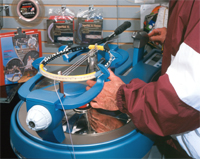
The rule is, string loose for power, tight for control. A slightly softer string bed will be more elastic and impart more rebound power to the ball. A tighter string bed will be flatter and facilitate greater control. For improved power with control, back down a couple pounds on tension, but use a string with a textured surface.
If your racquet is structurally sound, you don't need to buy a new one just because the paint is a little scratched or because it's last year's style. However, if you don't yet have a carbon fiber frame, you might consider an upgrade. In addition to the overall weight/strength advantages of carbon fiber, racquet manufacturers are constantly using additives and applying other technical wizardry to reduce weight even more, improve balance and torsional stiffness, and add power and control.
Restring your racquet. The beginning of the squash season is the ideal time to restring your racquet, whether the strings are broken or not. The general rule of thumb is that - barring any broken strings - you restring your racquet as many times a season as you play squash in a week. That means a player who steps onto the court five times a week, will most likely restring five times during the season.
Think about your string selection. Was your game all that you wanted it to be last season? A different string - or stringing differently - might give you a better edge. Or save you money. If you want more power you can either move to a string like Ashaway PowerNick® with its high tech Zyex® multifilament construction, or you can stay with the string you have and probably increase power by backing off on the tension a bit.
"What's that?" you say. "Back off on the tension?" That right. The rule is, string loose for power, tight for control, and it's one that even the top pros often get wrong. A slightly softer string bed will be more elastic and impart more rebound power to the ball. A tighter string bed will be flatter and facilitate greater control. If you want more power but fear losing control (over the ball, that is), back down a couple pounds on tension, but use a string with a textured surface like Ashaway's SuperNick® XL or XL Pro.
If economy is the name of this year's game, look to a more durable string. You may find that a heavier gauge string, or one of different construction, plays as well as your current string, but lasts even longer, reducing the frequency with which you need to restring. If you're unsure about string choice or what might work best for you, ask the squash pro at your club or a professional stringer. You can find one in your area by clicking here.
But whatever changes you decide to make to your regimen - or which the economy has decided for you - do get out and play by all means. This is especially true if you're one of the many who are currently out of work. Regular exercise can help relieve the stress of job hunting, and you never know who you might meet at the club or what opportunities might arise.
This article previously appeared in Squash Magazine.
Restring your racquet. The beginning of the squash season is the ideal time to restring your racquet, whether the strings are broken or not. The general rule of thumb is that - barring any broken strings - you restring your racquet as many times a season as you play squash in a week. That means a player who steps onto the court five times a week, will most likely restring five times during the season.
Think about your string selection. Was your game all that you wanted it to be last season? A different string - or stringing differently - might give you a better edge. Or save you money. If you want more power you can either move to a string like Ashaway PowerNick® with its high tech Zyex® multifilament construction, or you can stay with the string you have and probably increase power by backing off on the tension a bit.
"What's that?" you say. "Back off on the tension?" That right. The rule is, string loose for power, tight for control, and it's one that even the top pros often get wrong. A slightly softer string bed will be more elastic and impart more rebound power to the ball. A tighter string bed will be flatter and facilitate greater control. If you want more power but fear losing control (over the ball, that is), back down a couple pounds on tension, but use a string with a textured surface like Ashaway's SuperNick® XL or XL Pro.
If economy is the name of this year's game, look to a more durable string. You may find that a heavier gauge string, or one of different construction, plays as well as your current string, but lasts even longer, reducing the frequency with which you need to restring. If you're unsure about string choice or what might work best for you, ask the squash pro at your club or a professional stringer. You can find one in your area by clicking here.
But whatever changes you decide to make to your regimen - or which the economy has decided for you - do get out and play by all means. This is especially true if you're one of the many who are currently out of work. Regular exercise can help relieve the stress of job hunting, and you never know who you might meet at the club or what opportunities might arise.
This article previously appeared in Squash Magazine.
Ashaway Line & Twine Mfg. Co.
24 Laurel Street
Ashaway RI 02804
Telephone:
(800) 556-7260 (from within USA)
or (401) 377-2221
Copyright © 2026 Ashaway Line & Twine Mfg. Co. | All Rights Reserved