

Steve Crandall's Racquetball Stringing Tips
Those Big New Racquets With Their Long, Long Strings
By Steve Crandall
Vice President, Sales & Marketing
Ashaway Racket Strings
By Steve Crandall
Vice President, Sales & Marketing
Ashaway Racket Strings
The basic idea is simple: larger racquet faces have longer main strings, which means more power. The manufacturers achieve that in different ways, but one common design trick is to extend the length of the racquet's throat, and concentrate the bottom ends of most or all of the main strings at or near the throat. This imposes a fan-like pattern to the stringbed, and has the effect of lengthening the mains-particularly the outermost ones, as compared to a racquet with a traditional square-grid string pattern. Racquets that utilize this design include: Wilson Air Hammer® 9.9 Stretch; Head Ti.175 XL; Ektelon Power Ring Pro LongBodyTM; and the whole E-Force line.
Jonah Bishop, owner of Racquet Sports Unlimited in Pittsburgh, KS, and a professional stringer, reports that many skilled players prefer to use relatively stiff strings in these racquets. Otherwise, the ultra-long mains seem a bit too stretchy. But simultaneously, he's seen average stringing tensions drop from 35-40 lb. down to 30-35 lb. These two factors work against each other: the stiffer strings boost control and reduce power, while the lower tensions do the opposite. "In terms of racquet performance, I don't see an entirely logical explanation for this," says Bishop. "We're getting into a subjective area of what feels best to the player."
Jonah Bishop, owner of Racquet Sports Unlimited in Pittsburgh, KS, and a professional stringer, reports that many skilled players prefer to use relatively stiff strings in these racquets. Otherwise, the ultra-long mains seem a bit too stretchy. But simultaneously, he's seen average stringing tensions drop from 35-40 lb. down to 30-35 lb. These two factors work against each other: the stiffer strings boost control and reduce power, while the lower tensions do the opposite. "In terms of racquet performance, I don't see an entirely logical explanation for this," says Bishop. "We're getting into a subjective area of what feels best to the player."
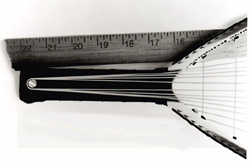
In terms of durability, however, this setup makes sense. The larger racquets have very "open" string patterns (i.e., a lot of space between the strings), which means less support for each string. Stiffer strings tend to be more notch-resistant, and strings at lower tension are obviously less prone to break from over-stretching.
Jonah likes a hybrid string setup in these larger racquets, which is one way to combine durability and stiffness with good power. Stiff Kevlar® for the longer main strings, and more resilient nylon for the shorter crosses seem to provide good consistent response.
Here are a few more points of interest from Jonah:
You may find that your "old" stringing setup doesn't generate the best results on the new racquets. As always, it's a good idea to discuss your needs with your stringer, and experiment with different setups until you find the one that brings out your best.
This article previously appeared in Racquetball Magazine.
Jonah likes a hybrid string setup in these larger racquets, which is one way to combine durability and stiffness with good power. Stiff Kevlar® for the longer main strings, and more resilient nylon for the shorter crosses seem to provide good consistent response.
Here are a few more points of interest from Jonah:
- E-Force's Omen™ and Torrent™ models feature a new Control Wrap™ design, in which the strings wrap around the head of the frame rather than passing through holes and grommets. This reduces the tightness of the bend the string must take, which may promote longer string life.
- Ektelon's "Power Ring" design seems to produce main strings that are most nearly equal in length. This should promote consistent response across the face of the racquet.
- In E-Force's LongStringTM design, on the other hand, there is great disparity between the length of the eight centermost mains, and the remaining outer ones. This doesn't seem to produce inconsistent response across the racquet face, however, so there's probably no need to set string tensions independently. Individual string tensioning is possible but difficult, and it adds cost to the stringing job.
- Players who do their own stringing will find that the standard 36' coil of string may not be long enough for the new oversize frames. Some manufacturers have increased their sets to 40' to make up the difference.
You may find that your "old" stringing setup doesn't generate the best results on the new racquets. As always, it's a good idea to discuss your needs with your stringer, and experiment with different setups until you find the one that brings out your best.
This article previously appeared in Racquetball Magazine.

Ashaway Line & Twine Mfg. Co.
24 Laurel Street
Ashaway RI 02804
Telephone:
(800) 556-7260 (from within USA)
or (401) 377-2221
Copyright © 2026 Ashaway Line & Twine Mfg. Co. | All Rights Reserved