

Steve Crandall's Racquetball Stringing Tips
Cliff Swain on String
By Steve Crandall
Vice President, Sales & Marketing
Ashaway Racket Strings
By Steve Crandall
Vice President, Sales & Marketing
Ashaway Racket Strings
Recently Ashaway announced that we would sponsor Hall of Famer and racquetball legend Cliff Swain. As part of that deal, Cliff has offered to share some of the wisdom he has accumulated over a 30+ year career about a subject near and dear to us: string.
Admittedly this is a somewhat unusual sponsorship arrangement for us as Cliff is officially retired from the IRT, but then Cliff is an unusual player, even by championship standards. He has won 71 IRT tournaments, has played in more IRT tournaments than any other (277), and has more professional match wins than any other player in history (730). Everybody in racquetball knows who he is and he plays with our string. Which, of course, is just fine with us!
After the most winning career in racquetball history, Cliff retired from the IRT in 2007, but has stayed active in doubles and outdoor racquetball, winning the USA Racquetball National Doubles Championship in 2008 with Woody Clouse; and in 2012 and 2013, teaming up with long-time friend and former coach Mike Ladge to win three national 45+ doubles titles. In 2014, he and partner Josh Tucker won the World Outdoor Racquetball (WOR) Pro doubles division taking out pros Rocky Carson and Jose Rojas in the semi finals.
Cliff is also a very sought after coach - his current roster includes Maria Jose Vargas, Jose Rojas, and Coby Iwaasa, among others - and is very active with youth leagues, teaching lessons and hosting clinics. In July 2014, Cliff introduced his own Cliff Swain Signature Series racquet, which features compressed graphite construction, displacement channels to improve in-plane stiffness, and a large 107 sq. in. string bed that maximizes string deflection and increases the sweet spot by 20%.
Admittedly this is a somewhat unusual sponsorship arrangement for us as Cliff is officially retired from the IRT, but then Cliff is an unusual player, even by championship standards. He has won 71 IRT tournaments, has played in more IRT tournaments than any other (277), and has more professional match wins than any other player in history (730). Everybody in racquetball knows who he is and he plays with our string. Which, of course, is just fine with us!
After the most winning career in racquetball history, Cliff retired from the IRT in 2007, but has stayed active in doubles and outdoor racquetball, winning the USA Racquetball National Doubles Championship in 2008 with Woody Clouse; and in 2012 and 2013, teaming up with long-time friend and former coach Mike Ladge to win three national 45+ doubles titles. In 2014, he and partner Josh Tucker won the World Outdoor Racquetball (WOR) Pro doubles division taking out pros Rocky Carson and Jose Rojas in the semi finals.
Cliff is also a very sought after coach - his current roster includes Maria Jose Vargas, Jose Rojas, and Coby Iwaasa, among others - and is very active with youth leagues, teaching lessons and hosting clinics. In July 2014, Cliff introduced his own Cliff Swain Signature Series racquet, which features compressed graphite construction, displacement channels to improve in-plane stiffness, and a large 107 sq. in. string bed that maximizes string deflection and increases the sweet spot by 20%.
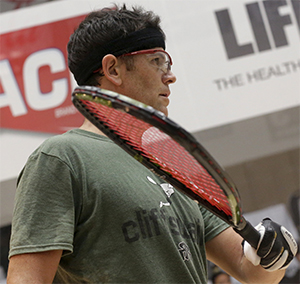
"String is the most inexpensive way to improve your game," said Cliff Swain. "It's silly to me that people would pay so much for a racquet, and for lessons and for all the other gear you can buy, and then not pay attention to their string."
Cliff has also announced that these new racquets will be strung with Ashaway string, which brings us back to our main topic. For a man who has played with just about every racquet ever made, and who now makes and sells his own racquets, Cliff is adamant about the value of string and stringing.
"String is the most inexpensive way to improve your game," he said. "It's silly to me that people would pay so much for a racquet (except for a certain brand, of course), and for lessons and for all the other gear you can buy, and then not pay attention to their string."
For his own game, Cliff uses Ashaway PowerKill® 17, which he says, "Is both lively and durable. I've had lively strings before and durable strings, but never both in the same string, until I started using Ashaway."
"You don't want your string to break in the middle of a match," he added. "I mean it happens, but a game is only 11 points. You can't afford to lose too many changing racquets. And when you do pick up a new racquet, you want it to play as close to the same way as possible to the previous racquet. Otherwise, the adjustment will probably cost you another point or two."
Cliff says he always has three racquets freshly strung before a tournament. "That way, if a string does break, I can pick up another racquet and feel sure it is not going to interrupt my play."
We asked Cliff how much the "right" string can affect a professional's game, and what advice he can offer players on how to choose the correct string for their game.
"The right string is critical to playing your best, Cliff said. "A good string is more lively, more powerful and more durable. Racquetball is a power sport. The trick is to get the most power without breaking strings or loosing control. For me, the PowerKill feels as lively as an 18 gauge string, but is as durable as a 16 gauge."
It all comes down to how the string feels," he said. "That is true for all players at all levels. Some players say they are control players, but they still need to get as much power as they can.
A bad string will feel heavy or dead. A good string will feel lively and make the ball feel lighter. But if the string is too light, you will start breaking string. For a pro, this usually means loss of a point. For an amateur, it means paying for another restringing job."
Cliff also has four hard and fast rules about stringing that should apply to all players. "After you figure out what string is best for your game you should: 1) always string at the same tension; 2) use the same stringing machine; 3) restring regularly; and 4) use a quality string."
"String is the most inexpensive way to improve your game," he said. "It's silly to me that people would pay so much for a racquet (except for a certain brand, of course), and for lessons and for all the other gear you can buy, and then not pay attention to their string."
For his own game, Cliff uses Ashaway PowerKill® 17, which he says, "Is both lively and durable. I've had lively strings before and durable strings, but never both in the same string, until I started using Ashaway."
"You don't want your string to break in the middle of a match," he added. "I mean it happens, but a game is only 11 points. You can't afford to lose too many changing racquets. And when you do pick up a new racquet, you want it to play as close to the same way as possible to the previous racquet. Otherwise, the adjustment will probably cost you another point or two."
Cliff says he always has three racquets freshly strung before a tournament. "That way, if a string does break, I can pick up another racquet and feel sure it is not going to interrupt my play."
We asked Cliff how much the "right" string can affect a professional's game, and what advice he can offer players on how to choose the correct string for their game.
"The right string is critical to playing your best, Cliff said. "A good string is more lively, more powerful and more durable. Racquetball is a power sport. The trick is to get the most power without breaking strings or loosing control. For me, the PowerKill feels as lively as an 18 gauge string, but is as durable as a 16 gauge."
It all comes down to how the string feels," he said. "That is true for all players at all levels. Some players say they are control players, but they still need to get as much power as they can.
A bad string will feel heavy or dead. A good string will feel lively and make the ball feel lighter. But if the string is too light, you will start breaking string. For a pro, this usually means loss of a point. For an amateur, it means paying for another restringing job."
Cliff also has four hard and fast rules about stringing that should apply to all players. "After you figure out what string is best for your game you should: 1) always string at the same tension; 2) use the same stringing machine; 3) restring regularly; and 4) use a quality string."

Ashaway Line & Twine Mfg. Co.
24 Laurel Street
Ashaway RI 02804
Telephone:
(800) 556-7260 (from within USA)
or (401) 377-2221
Copyright © 2026 Ashaway Line & Twine Mfg. Co. | All Rights Reserved