

Steve Crandall's Squash Stringing Tips
It's Not Too Early For A Pre-Season Tune Up
By Steve Crandall
Vice President, Sales & Marketing
Ashaway Racket Strings
By Steve Crandall
Vice President, Sales & Marketing
Ashaway Racket Strings
The dog days of summer may still be upon us, but it's not too early to start thinking about the upcoming squash season. It may even provide a little mental relief from the heat. Now may also be a good time to clean out your gym bag (oh, that's where those socks went!) and give your equipment a thorough pre-season tune-up.
Start at the bottom and check your shoes. While they do not need to be as bright and clean as they were when you took them out of the box, make sure that the soles are intact. A worn or uneven sole can make maneuvering your way around the squash court a risky proposition. A slip can cost points or even cause an injury. You might also want to check out some of the new shoes that have come on the market recently that are designed specifically for playing squash. They offer better support for the entire foot and the soles are designed to provide maximum traction on all indoor court surfaces, including finished court surfaces, as well as sanded squash courts.
Start at the bottom and check your shoes. While they do not need to be as bright and clean as they were when you took them out of the box, make sure that the soles are intact. A worn or uneven sole can make maneuvering your way around the squash court a risky proposition. A slip can cost points or even cause an injury. You might also want to check out some of the new shoes that have come on the market recently that are designed specifically for playing squash. They offer better support for the entire foot and the soles are designed to provide maximum traction on all indoor court surfaces, including finished court surfaces, as well as sanded squash courts.

Also take a look at the grip on your racquet. Is it worn to the point of compromised performance? Does it still provide both traction and comfort? If your grip has flattened out, you may be holding the racquet handle too tightly. This could throw off your ability to make key touch shots. You may also want to consider a specialized grip that provides shock absorption to decrease the likelihood of joint injuries and muscle fatigue.
Next stop on your pre-season inspection should be your frame. Check it closely for cracks. A tiny crack that happened last season may have grown, depending on how the racquet was stored during the off season. Improper storage may also account for bent or warped frames. Either of these problems can hinder performance.
If your racquet is structurally sound, you don't need to buy a new one just because the paint is a little scratched or because it's last year's style. However, if you don't yet have a carbon fiber frame, you should probably consider an upgrade. In addition to weight/strength advantages, they offer a number of new features such as strategic stringing nodes for enhanced string performance and maximum kinetic advantage; larger "O-port" holes, and two-part heads with string "channels," instead of holes, which increase sweet spots; and other technical wizardry which improves balance, torsional stiffness, and power with control.
While you are surveying your racquet frame, check that your grommet strip is intact. Worn or damaged grommet strips can cause damage to your racquet and cause your string to break prematurely.
Next stop on your pre-season inspection should be your frame. Check it closely for cracks. A tiny crack that happened last season may have grown, depending on how the racquet was stored during the off season. Improper storage may also account for bent or warped frames. Either of these problems can hinder performance.
If your racquet is structurally sound, you don't need to buy a new one just because the paint is a little scratched or because it's last year's style. However, if you don't yet have a carbon fiber frame, you should probably consider an upgrade. In addition to weight/strength advantages, they offer a number of new features such as strategic stringing nodes for enhanced string performance and maximum kinetic advantage; larger "O-port" holes, and two-part heads with string "channels," instead of holes, which increase sweet spots; and other technical wizardry which improves balance, torsional stiffness, and power with control.
While you are surveying your racquet frame, check that your grommet strip is intact. Worn or damaged grommet strips can cause damage to your racquet and cause your string to break prematurely.
Speaking of broken strings, the beginning of the squash season is the ideal time to restring your racquet, whether the strings are broken or not. The general rule of thumb is that - barring any broken strings - you restring your racquet as many times a season as you play squash in a week. That means a player who steps onto the court five times a week, will most likely restring five times during the season.
This is also an excellent opportunity to check that you are playing with a string that best matches your style of play. Think back to last season - did your string give you the feel, playability, tension, power, and durability you were looking for? If you aren't sure, try playing a trial match or two with the string currently in your racquet. Then, evaluate whether or not your string is giving you the level of performance you desire.
If you want to make a switch, but are unsure about what string might be best for you, ask for help. The squash pro at your club is an invaluable resource, and can work with you to determine the right string setup for your style of play. He or she offers a great way to learn about new strings that have come on the market, too. You can also find a professional stringer in your area by visiting the Ashaway web site at www.ashawayusa.com and clicking on, "Locate a Professional Racquet Stringer Near You." Either way, finding the squash string with the right combination of characteristics for your playing needs just might be the thing to take your game to the next level this season.
This is also an excellent opportunity to check that you are playing with a string that best matches your style of play. Think back to last season - did your string give you the feel, playability, tension, power, and durability you were looking for? If you aren't sure, try playing a trial match or two with the string currently in your racquet. Then, evaluate whether or not your string is giving you the level of performance you desire.
If you want to make a switch, but are unsure about what string might be best for you, ask for help. The squash pro at your club is an invaluable resource, and can work with you to determine the right string setup for your style of play. He or she offers a great way to learn about new strings that have come on the market, too. You can also find a professional stringer in your area by visiting the Ashaway web site at www.ashawayusa.com and clicking on, "Locate a Professional Racquet Stringer Near You." Either way, finding the squash string with the right combination of characteristics for your playing needs just might be the thing to take your game to the next level this season.
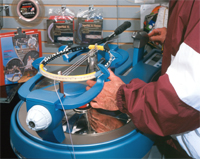
The start of the squash season is an ideal time to restring your racquet, whether the strings are broken or not.
Ashaway Line & Twine Mfg. Co.
24 Laurel Street
Ashaway RI 02804
Telephone:
(800) 556-7260 (from within USA)
or (401) 377-2221
Copyright © 2026 Ashaway Line & Twine Mfg. Co. | All Rights Reserved